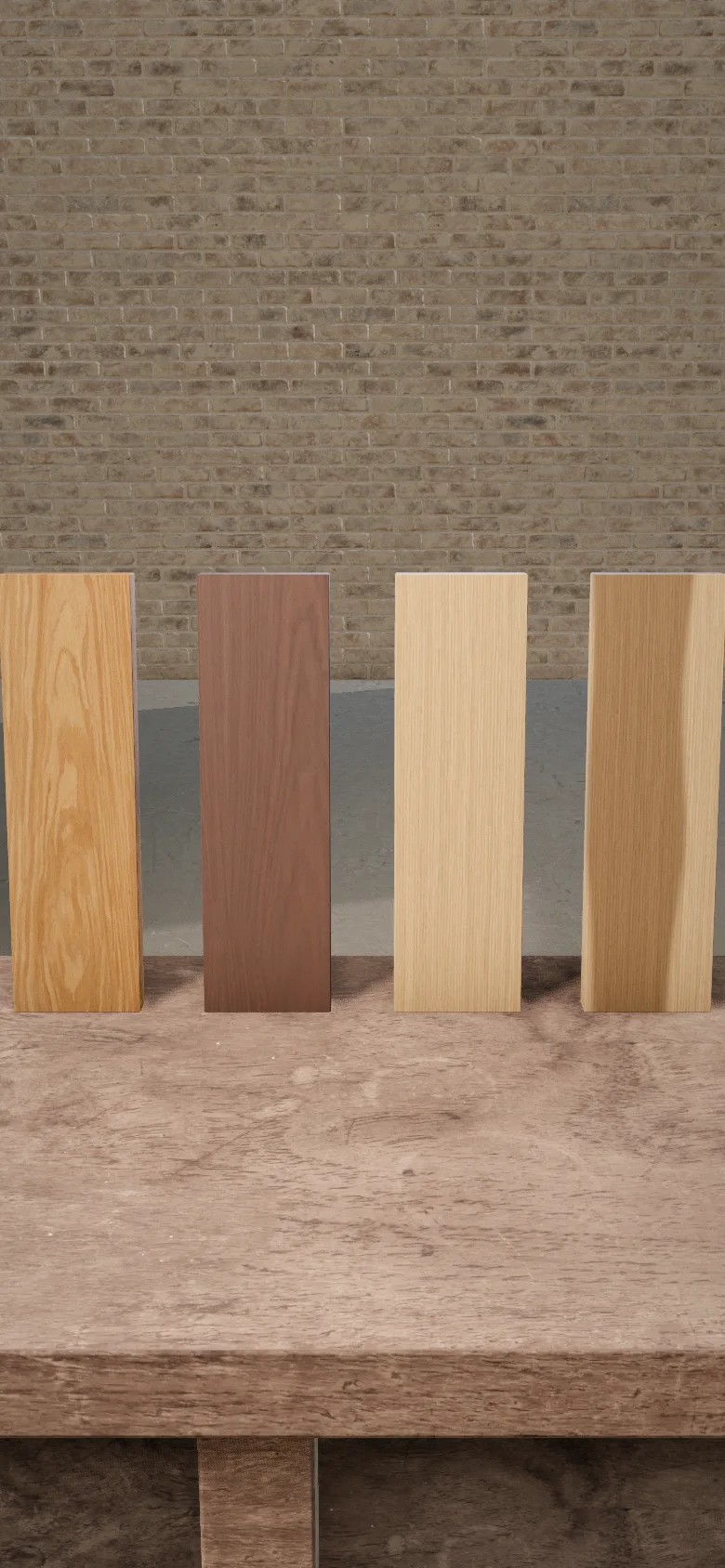
Four boards. Three species.
Compare appearance, working properties and suitable uses. Property figures are cited or labelled illustrative.
Rendered illustration · oak, walnut, ash and olive ash · hardwax oiled · workshop light
Working properties
Four boards over three species. Every cell is cited and dated, or set in [ brackets ] and labelled illustrative. No durability class is assigned here; the cited species descriptions do not establish a tested class for a particular board or finished piece.
| Property | European oak Quercus robur | American black walnut Juglans nigra | European ash Fraxinus excelsior | Olive ash Fraxinus excelsior |
|---|---|---|---|---|
| Density at 12 % moisture content | 720 kg/m³4 | 660 kg/m³6 | 710 kg/m³5 | 710 kg/m³5 |
| Moisture movement | Medium4 | Medium6 | Medium5 | Medium5 |
| Natural durability, heartwood | Durable to slightly durable4 | Moderately durable6 | Not durable5 | Not durable5 |
| Treatability | Heartwood extremely difficult; sapwood easy4 | Extremely difficult6 | Moderately easy5 | Moderately easy5 |
| Working qualities | Medium to difficult. Machines easily or with moderate difficulty depending on how the tree grew and how the board was dried; quarter-sawn faces need careful planing to avoid tearing the grain.4 | Works easily and well with hand and machine tools, takes hand carving and turnery, and finishes cleanly from the tool.6 | Good. Tough, but works and machines well to a reasonably smooth finish, and takes glue, stain and polish.5 | Good. Tough, but works and machines well to a reasonably smooth finish, and takes glue, stain and polish.5 |
| Drying | Very slow, with a marked tendency to split and check in the early stages, and a honeycombing risk if forced.4 | Rather slow, with a tendency to honeycomb.6 | Fairly rapid without excessive surface checking or splitting, though it can distort under severe conditions and end-split.5 | Fairly rapid without excessive surface checking or splitting, though it can distort under severe conditions and end-split.5 |
| Shrinkage, green to ovendry | [ No dated figure published here ] illustrative | Radial 5.5 %, tangential 7.8 %, volumetric 12.8 %7 | [ No dated figure published here ] illustrative | [ No dated figure published here ] illustrative |
| Typical uses | Interior joinery, exterior joinery, flooring, furniture, cladding, decking, heavy structural work, sleepers.4 | Furniture.6 | Interior joinery, furniture, flooring.5 | Interior joinery, furniture, flooring.5 |
- 720Oak
- 660Walnut
- 710Ash
- 710Olive ash
Two of those columns are one species
Fraxinus excelsior L., family Oleaceae. European ash and Olive ash come from the same species. Olive ash contains decorative dark heartwood streaks; pale ash has a more even appearance. Ask to see boards together when a consistent colour or a continuous figure matters.
Ash and olive ash are the same species. Olive ash is cut through the darker, streaked heartwood; the pale outer wood is sold as ash.
What each board is unsuitable for
Start with the conditions the finished piece will face. These notes flag material and programme limitations to discuss before specifying.
- European oak
- Any application needing preservative to penetrate the heartwood, which is extremely difficult to treat.4
- A programme with no drying time in it. Oak dries very slowly and splits, checks and honeycombs if it is hurried.4
- [ Contact with ferrous fixings where the timber may be wetted: the reaction stains the oak blue-black and attacks the fixing. ] illustrative
- American black walnut
- Work needing treated heartwood: it is extremely difficult to treat.6
- European ash
- Anything exposed to wetting, inside or out. Ash heartwood is not durable, and no finish makes it so.5
- Olive ash
- Anything exposed to wetting. It is the same species as ash and carries the same durability: not durable.5
- [ A long run that must match along its length. The streak is a natural heart feature and it moves from board to board, which is the reason to choose it and the reason it cannot be matched. ] illustrative
Sources and reference scope
- 4tduk-oak
- Timber Development UKWood Species — Oak, Europeanreproduced by TDUK from the TRADA Red Books and Wood Information Sheets; 139-species librarytimberdevelopment.ukRead 2026-09-12
- 5tduk-ash
- Timber Development UKWood Species — Ash, Europeanreproduced by TDUK from the TRADA Red Books and Wood Information Sheets; 139-species librarytimberdevelopment.ukRead 2026-09-12
- 6tduk-walnut
- Timber Development UKWood Species — Walnut, Americanreproduced by TDUK from the TRADA Red Books and Wood Information Sheets; 139-species librarytimberdevelopment.ukRead 2026-09-12
- 7fpl-282-ch4
- U.S. Department of Agriculture, Forest Service, Forest Products LaboratoryGlass, S.V.; Zelinka, S.L. 2021. Chapter 4: Moisture relations and physical properties of wood. In: Wood handbook — wood as an engineering materialGeneral Technical Report FPL-GTR-282. Madison, WIresearch.fs.usda.govRead 2026-09-12
- 8fpl-282-ch5
- U.S. Department of Agriculture, Forest Service, Forest Products LaboratorySenalik, C.A.; Farber, B. 2021. Chapter 5: Mechanical properties of wood. In: Wood handbook — wood as an engineering materialGeneral Technical Report FPL-GTR-282. Madison, WI. 46 ppresearch.fs.usda.govRead 2026-09-12
- 11fpl-structure
- USDA Forest Products LaboratoryStructure and Function of WoodWiedenhoeft and Miller, 2005, p. 17research.fs.usda.govRead 2026-09-13
- 9gbif-backbone
- Global Biodiversity Information FacilityGBIF Backbone Taxonomy — species/match APIqueried with strict=true for each binomialapi.gbif.orgRead 2026-09-12