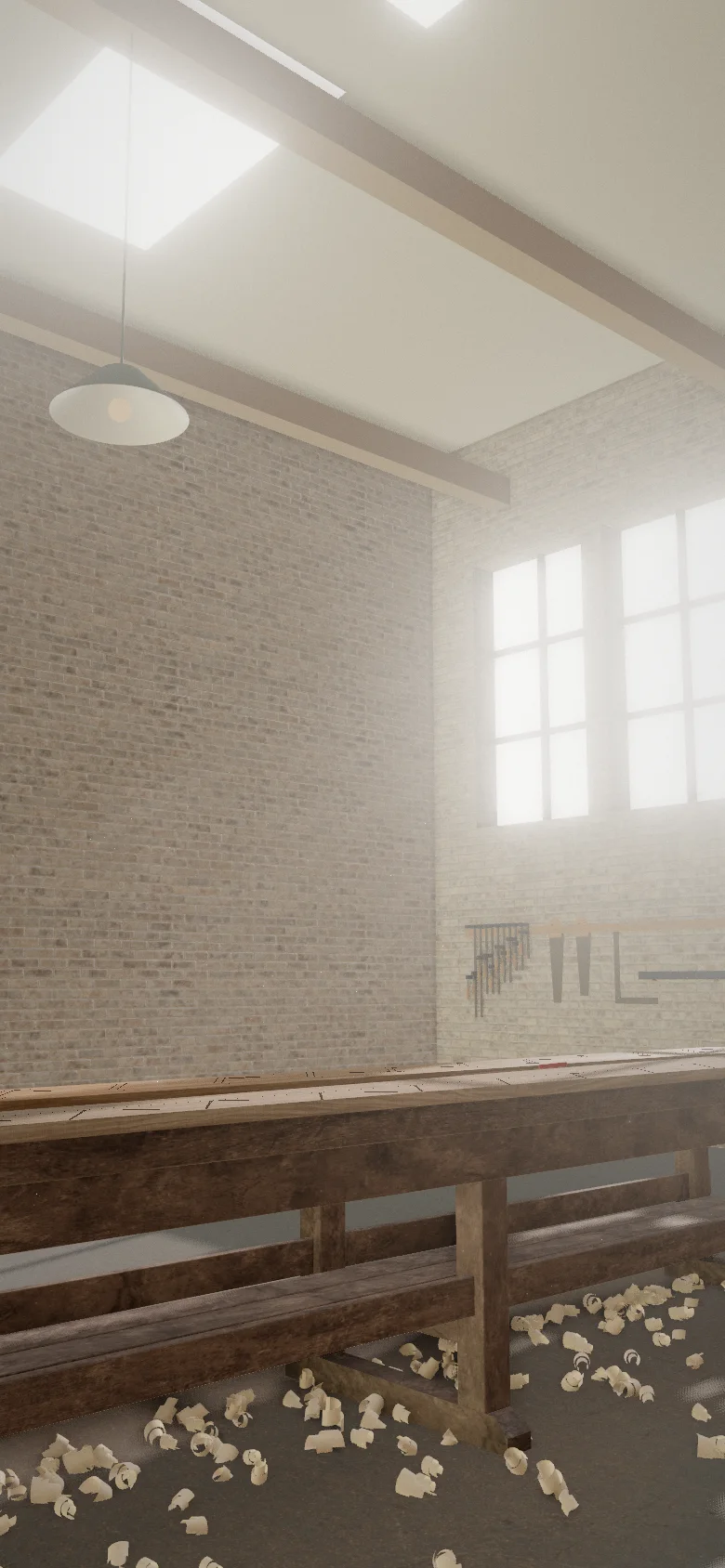


Rendered, not photographed. Ulcombe Joinery is a demonstration; the workshop does not exist.
01 · Arrival
Made around the way you live.
Staircases, kitchens, doors and furniture in oak, walnut and ash.
A board in the last of the sun
European oak, sawn through and left to settle. Every piece we make starts as a board like this one, chosen for where its grain will show.
02 · Setting out
Drawn full size before anything is cut
Pencil for the lines we keep, a knife for the lines we cut to, and a gauge run down the edge. The rise, the going and every joint are taken off these lines.
03 · Cut
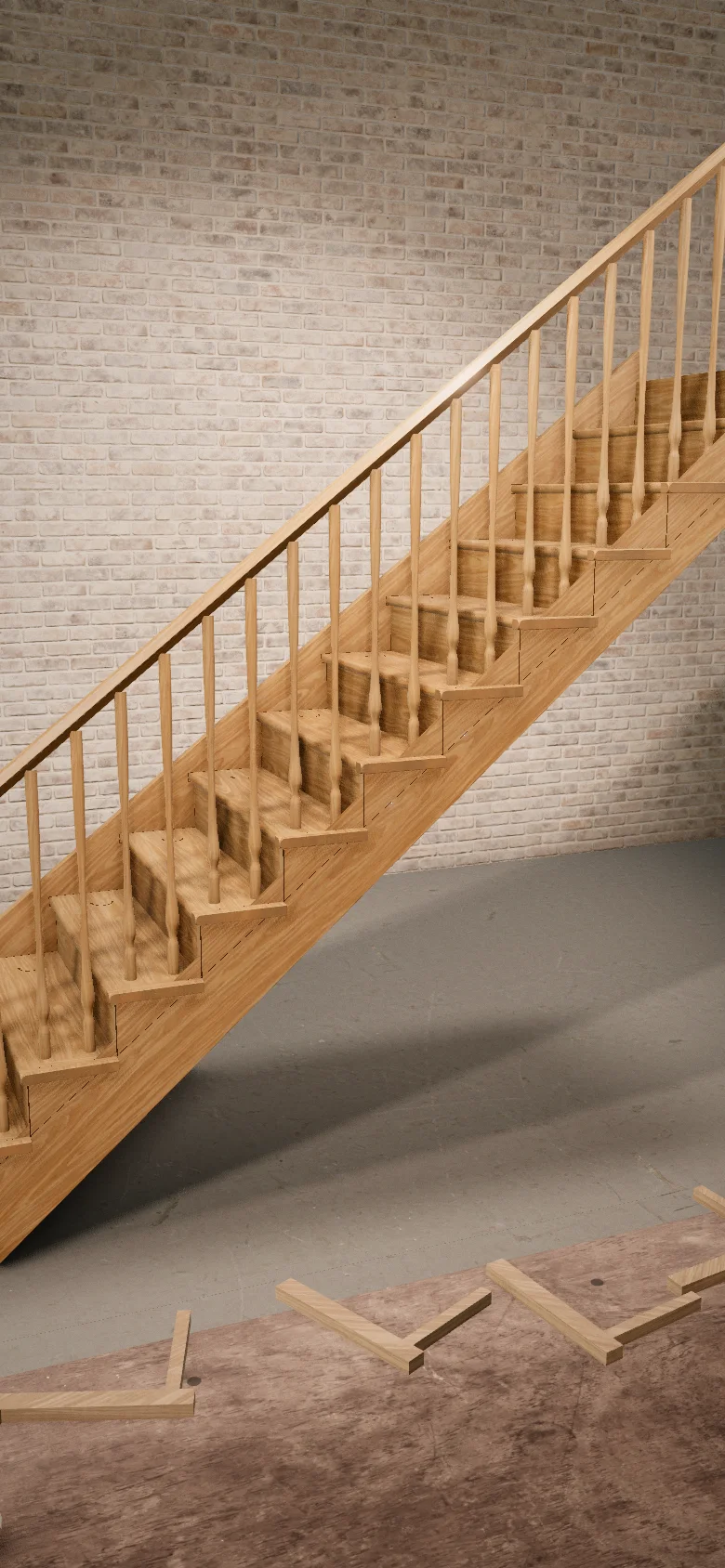
The string, cut to the knife line
A rise and a going for every step, sawn on the waste side of the line. The waste drops away and leaves the profile each tread and riser will sit on.
04 · Dry fit
The whole flight, put together without glue
Strings, treads, risers, newel, balusters and handrail, assembled in the order they will go together on site, to prove that every joint closes.
- Risers
- 13
- Treads
- 12
- Going
- 240 mm
- Pitch
- 38.4°
- Twice the rise plus the going
- 620 mm
- Balusters
- 24, 88 mm clear
- Price band
- £14,000 – £19,000 illustrative
- Lead time
- 11 – 14 weeks illustrative
05 · Finished
Oiled by hand, seen in the light it will live in
Hardwax oil deepens the grain and brings up the figure. The flight is then checked in daylight and in warm evening light before it leaves the workshop.
Your staircase, to your dimensions
Change the width and the rise and the going, pitch, baluster spacing and cutting list follow. Or start with a kitchen, a door or a piece of furniture.
Rendered, not photographed. Ulcombe Joinery is a demonstration; the workshop does not exist.
A different character in every board.
From the quiet grain of oak to the dark heart of olive ash, choose a timber for its appearance, working properties and the way it will be used.
European oak
Quercus robur
quarter-sawn
Quarter-sawn so the medullary rays are cut along their length, which is what produces the silver fleck that flares and dies as you move. A mid honey-brown that darkens with light.
American black walnut
Juglans nigra
crown-cut
A rich brown heartwood with pale sapwood and varied figure. Black walnut is commonly described as semi-ring-porous; the transition in vessel size is gradual and the appearance varies between boards.11
European ash
Fraxinus excelsior
through-and-through
The palest of the four, almost cream, and the one where the wood anatomy is plainly visible: the coarsest and most legible pore rows of the set, running long and straight.
Olive ash
Fraxinus excelsior
through-and-through
The same tree as the ash above, cut from the heart instead of the outer wood. An olive-to-chocolate streak wanders across the board while the pore rows run straight through it, which is what tells you the figure is the timber and not a print.