Freestanding furniture
Tables, cabinets and casework that bring the grain into everyday use.
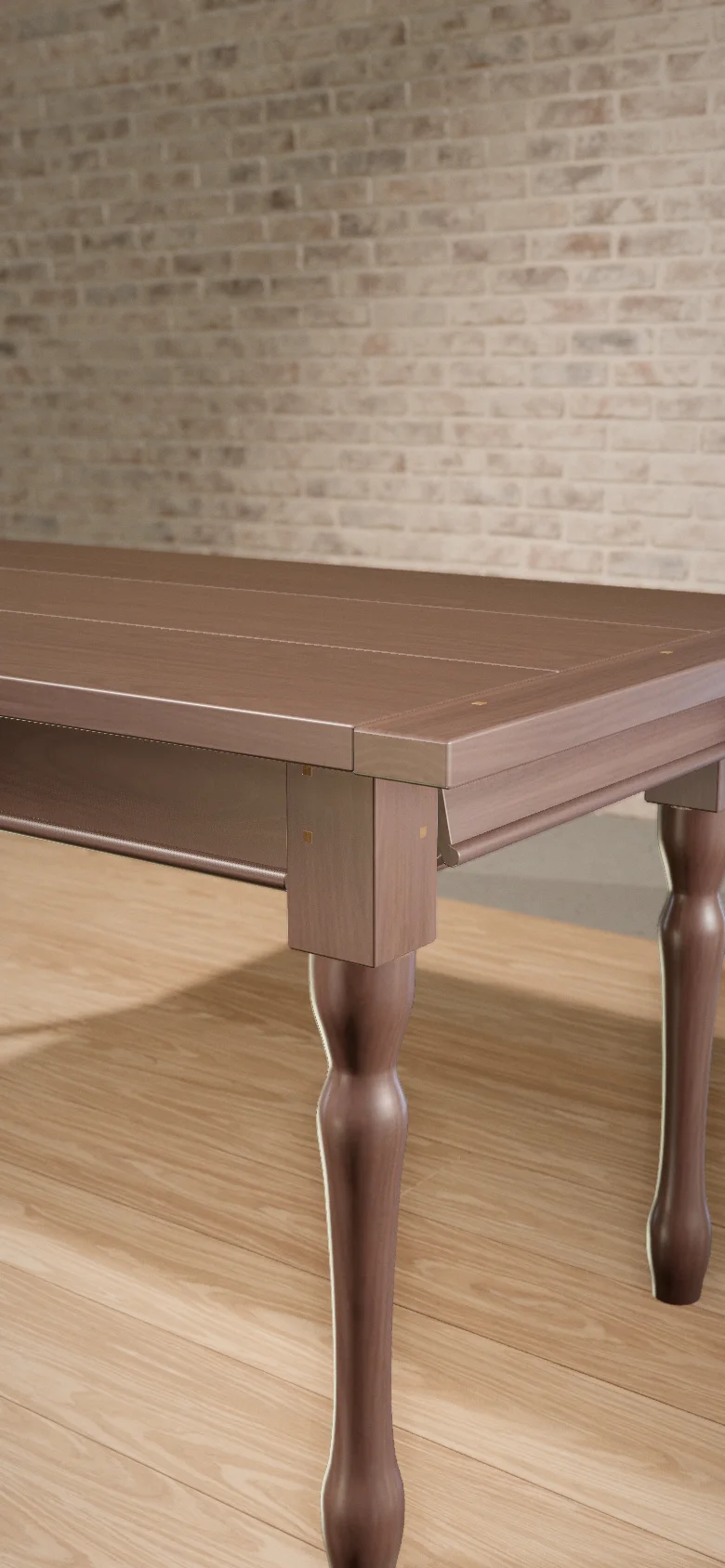
Rendered illustration · Walnut table on turned legs · lacquered finish · workshop light
A useful piece, well proportioned
The first decisions are what it will hold, how it will be used and where it will sit. A table, cabinet or fitted piece starts with those practical dimensions.
Turned legs and quiet details
A turned leg changes section along its length. Its square upper part provides a place for the frame joints; the curved section beneath gives the piece its profile.
Room for timber to move
A solid top expands and contracts across the grain as humidity changes. Its fixings allow that movement while holding it securely to the frame.
The four boards
Compare appearance, working properties and suitable uses. Property figures are cited or labelled illustrative.
European oak
Quercus robur
quarter-sawn
Quarter-sawn so the medullary rays are cut along their length, which is what produces the silver fleck that flares and dies as you move. A mid honey-brown that darkens with light.
American black walnut
Juglans nigra
crown-cut
A rich brown heartwood with pale sapwood and varied figure. Black walnut is commonly described as semi-ring-porous; the transition in vessel size is gradual and the appearance varies between boards.11
European ash
Fraxinus excelsior
through-and-through
The palest of the four, almost cream, and the one where the wood anatomy is plainly visible: the coarsest and most legible pore rows of the set, running long and straight.
Olive ash
Fraxinus excelsior
through-and-through
The same tree as the ash above, cut from the heart instead of the outer wood. An olive-to-chocolate streak wanders across the board while the pore rows run straight through it, which is what tells you the figure is the timber and not a print.
The four finishes
Choose a finish for its feel, the wear it will receive and the repair it may need. Compare the four surfaces in the finish guide.
- Hardwax oiled
- The oil is in the wood, not on it. Grain slightly darkened and deepened, a broad low sheen, the pore rows still open and catching their own shadow. Nothing reflects in it. illustrative
- Waxed
- A soft bloom sitting above the surface rather than in it — the light scatters off the film before it reaches the timber. illustrative
- Lacquered
- A film, and you can see it is a film: a tight specular highlight that travels independently of the grain, pore rows filled and flattened, the arris reading as a hard bright line. illustrative
- Fumed
- An oiled surface over a much darker wood, because the colour is in the timber and not in the gloss. In oak the ray fleck now flares against something close to black, which is the best thing this finish does and the reason it is in the set. illustrative